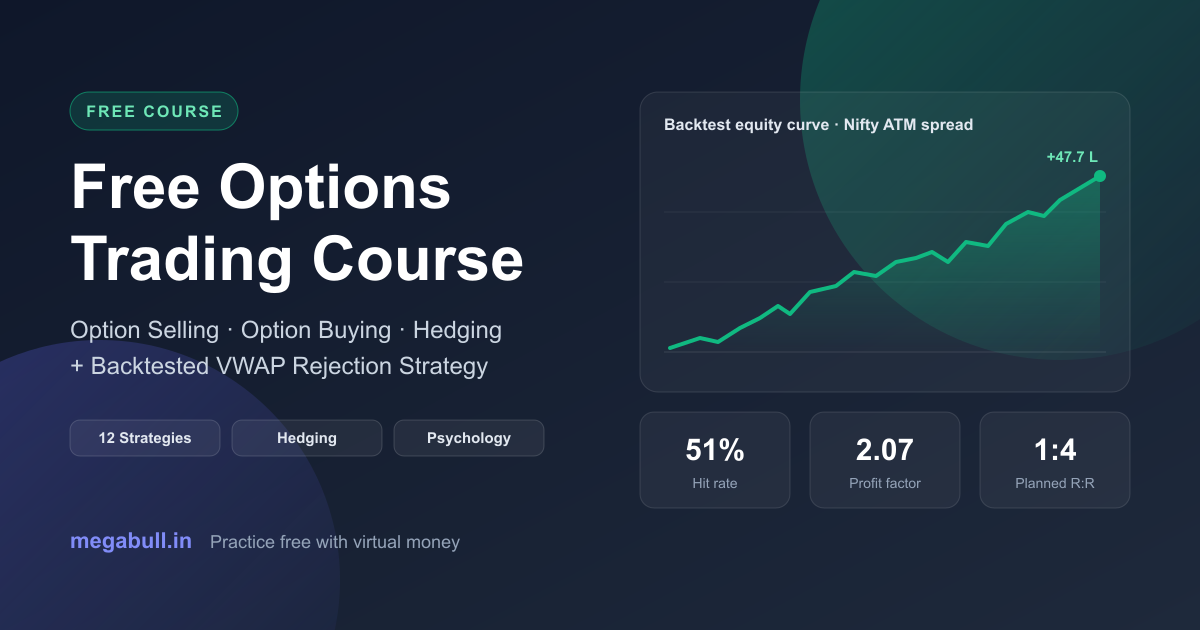
Most people pay thousands of rupees for an options trading course and still don't know when to buy an option, when to sell one, or how to stop a single bad day from wiping out a month of profits. This free options trading course covers all of it in one place: the advantages of option selling and option buying, who each approach suits, how hedging works, 12 core option trading strategies (with a free PDF), and a complete, backtested Nifty setup with its real numbers, drawdowns included.
- Options basics in 5 minutes
- Advantages of option buying
- Advantages of option selling, and who it suits
- Hedging in option selling
- 12 option trading strategies (PDF)
- The 15-minute VWAP rejection strategy, with backtest results
- Trading psychology: focus on execution, not on single trades
- Practise everything free on MegaBull
Module 1: Options Basics in 5 Minutes
An option is a contract that gives the buyer the right, but not the obligation, to buy or sell an underlying asset such as Nifty at a fixed price (the strike) before a fixed date (the expiry). The price of an option is called the premium.
- Call option (CE): Gains when the underlying rises. Buyers are bullish, sellers are neutral to bearish.
- Put option (PE): Gains when the underlying falls. Buyers are bearish, sellers are neutral to bullish.
- ATM / ITM / OTM: At-the-money is the strike closest to spot. If Nifty is at 23,213, the 23,200 strike is ATM, because Nifty strikes are listed at 50-point intervals.
- Time decay (theta): Option premium loses value every day as expiry approaches, all else equal. This is the seller's edge and the buyer's enemy.
- Implied volatility (IV): The market's expectation of future movement. High IV makes options expensive, low IV makes them cheap.
- Lot size: Index options trade in fixed lots set by NSE. Your quantity is always a multiple of the lot size.
Every option trade has two sides. The buyer pays the premium and wants a big move. The seller collects the premium and wants the move to be small, slow, or in the other direction. Understanding which side you are on, and why, is the foundation of every strategy below.
Module 2: Advantages of Option Buying
Option buying is where most beginners start, and for good reason. It is simple to understand and the worst case is known before you enter.
- Limited, known risk: The most you can lose is the premium you paid. There are no margin calls and no surprise losses beyond that amount.
- Low capital requirement: You only pay the premium, so you can take a position in Nifty for a few thousand rupees instead of lakhs of margin.
- Unlimited upside on big moves: If Nifty moves sharply in your direction, a ₹50 option can become ₹200 or more. This asymmetry is called convexity.
- Benefits from rising volatility: When IV expands, such as ahead of a major event or during a sell-off, option prices rise even before the underlying moves much.
- Simple to manage: One leg, one stop loss, one target. No adjustments needed.
The catch: an option buyer needs to be right about direction, size of the move, and timing, all at once. If the market goes sideways, time decay slowly drains the premium. That is why low hit rates are normal for option buyers, and why they need winners that are several times larger than their losers.
Module 3: Advantages of Option Selling
Option selling, also called option writing, flips the equation. You collect premium up front and profit if the option loses value. Many full-time traders in India build their core income around selling, because the odds are structurally on the seller's side.
- Time decay works for you: Every day that passes without a big move, the option you sold loses value. You get paid for patience.
- Higher probability of profit: A seller wins if the market goes against the buyer, stays flat, or moves only slightly in the buyer's favour. Three out of four scenarios work.
- Profits in sideways markets: Markets spend a large part of their time in ranges. Buyers struggle in ranges; sellers thrive.
- Gains from volatility crush: After events such as results or policy announcements, IV often collapses. Sellers benefit even if the price barely moves.
- Flexible and adjustable: Spreads can be rolled, widened, or converted into other structures as the market changes.
- Smoother equity curve: With proper hedging and sizing, selling strategies tend to produce steadier returns than pure buying.
The catch: a naked short option has limited profit (the premium) and potentially very large losses. A single gap-up or gap-down can erase weeks of gains. That's why serious sellers always hedge, and why selling demands more capital and discipline.
Who Does Option Selling Suit?
- Traders with adequate capital: Margin for selling is much higher than the premium for buying. A hedge reduces it, but you still need a meaningful account.
- Process-driven, patient traders: Selling rewards people who follow rules day after day, not those chasing excitement.
- People who can sit through drawdowns: Sellers win often but lose in bigger chunks when wrong. You need the temperament to accept that.
- Part-time traders using defined rules: A rule-based, hedged setup like the one in Module 6 can be checked every 15 minutes or automated.
- Not for: traders with very small accounts, anyone who refuses to use stop losses, or anyone who would sell naked options to "earn a small daily income".
Option Buying vs Option Selling at a Glance
| Factor | Option Buying | Option Selling |
|---|---|---|
| Maximum risk | Premium paid | Large (unlimited if naked, capped if hedged) |
| Maximum reward | Large | Premium collected |
| Capital needed | Low | High (lower with a hedge) |
| Typical hit rate | Lower | Higher |
| Time decay | Works against you | Works for you |
| Best market | Trending, volatile | Range-bound, high IV |
| Suits | Small accounts, momentum traders | Disciplined traders with capital |
Module 4: Hedging in Option Selling
A hedge is a position you take to limit the damage if your main trade goes wrong. In option selling, the standard hedge is simple: when you sell an option, you also buy a further out-of-the-money option of the same type. The combined position is called a credit spread.
- Sell a call → buy a higher-strike call. This is a bear call spread.
- Sell a put → buy a lower-strike put. This is a bull put spread.
Worked Example: A 150-Point Hedge
Suppose Nifty is at 23,213 and you want to sell the ATM 23,200 call. The premiums below are illustrative.
| Leg | Action | Premium |
|---|---|---|
| 23,200 CE | Sell | ₹120 |
| 23,350 CE (hedge, 150 pts away) | Buy | ₹55 |
| Net credit | ₹65 |
- Maximum profit: ₹65 × quantity, if Nifty stays below 23,200.
- Maximum loss: (150 − 65) = ₹85 × quantity, no matter how far Nifty rallies. With 1,300 quantity, that is about ₹1.1 lakh.
- Without the hedge: a 400-point gap-up would put the short call roughly ₹400+ in the money, a loss of over ₹5 lakh on the same quantity.
Why Every Option Seller Should Hedge
- Caps the worst case: You know your maximum loss before entering, just like an option buyer.
- Protects against overnight gaps: Stop losses don't work on gaps. A hedge does.
- Lowers margin: Exchange margin rules recognise the reduced risk, so a hedged spread usually needs far less margin than a naked short.
- Lets you sleep: Carrying a hedged position overnight is a calculated risk. Carrying a naked one is a gamble.
Choosing hedge width: a closer hedge costs more premium and reduces profit, but caps losses tightly. A wider hedge keeps more premium but allows larger losses. The strategy below uses a 150-point hedge on Nifty, a practical middle ground.
Module 5: 12 Option Trading Strategies (Free PDF)
These are the 12 option trading strategies every Indian trader should know. Each one is a tool for a specific market view. Pick the strategy that matches your view, not the other way round.
| Strategy | Market View | How to Build It | Max Risk | Works Best When |
|---|---|---|---|---|
| Long Call | Bullish | Buy 1 ATM/OTM call | Premium paid | Fast up-move, low IV |
| Long Put | Bearish | Buy 1 ATM/OTM put | Premium paid | Fast down-move, low IV |
| Covered Call | Mildly bullish | Own stock/future + sell OTM call | Downside of the stock | Slow grind up, earning extra income |
| Protective Put | Bullish, insured | Own stock/future + buy put | Limited to put strike | Holding through events |
| Bull Call Spread | Moderately bullish | Buy ATM call + sell higher call | Net debit | Cheaper directional bet |
| Bear Put Spread | Moderately bearish | Buy ATM put + sell lower put | Net debit | Cheaper directional bet |
| Bull Put Spread | Neutral to bullish | Sell put + buy lower put (hedge) | Width − credit | Support holding, high IV |
| Bear Call Spread | Neutral to bearish | Sell call + buy higher call (hedge) | Width − credit | Resistance holding, high IV |
| Long Straddle | Big move, either side | Buy ATM call + ATM put | Both premiums | Before events, low IV |
| Short Straddle | Range-bound | Sell ATM call + ATM put | Unlimited (hedge it → Iron Fly) | High IV, quiet market |
| Short Strangle | Wide range | Sell OTM call + OTM put | Unlimited (hedge it) | High IV, no news ahead |
| Iron Condor | Range-bound | Short strangle + buy further OTM wings | Wing width − credit | Defined-risk premium selling |
Want to see how multi-leg structures behave before trading them? Build them in our options simulator for Nifty & Bank Nifty and track drawdown, win rate and P&L with virtual money.
Module 6: The "Secret" Strategy: 15-Minute VWAP Rejection on ATM Nifty Options
Here is the setup this course is built around. It isn't really a secret. The edge doesn't come from the idea, it comes from following simple rules on every signal for hundreds of trades. It combines three concepts from earlier modules: option selling (time decay on our side), a VWAP rejection (a clear, objective entry), and a 150-point hedge (capped risk).
The Rules
- Pick the ATM strike. Round Nifty spot to the nearest 50-point strike. If Nifty is at 23,213, track the 23,200 CE and 23,200 PE.
- Open a 15-minute chart of the option premium (not the Nifty chart) with VWAP plotted on it.
- Check every 15 minutes, at each candle close, for a VWAP rejection: the premium rallies up to or through VWAP, fails to hold, and the candle closes back below VWAP with a bearish rejection.
- Short that candle. Sell the ATM option whose premium was rejected from VWAP.
- Place the stop loss just above the high of the rejection candle. The distance from entry to stop is your risk (1R).
- Set the target at 1:4 risk-reward: four times the risk below your entry.
- Hedge immediately with a 150-point OTM option of the same type: sold the 23,200 CE → buy 23,350 CE; sold the 23,200 PE → buy 23,050 PE.
- Hold until stop or target. Positions can be carried overnight. The hedge is what makes that acceptable.
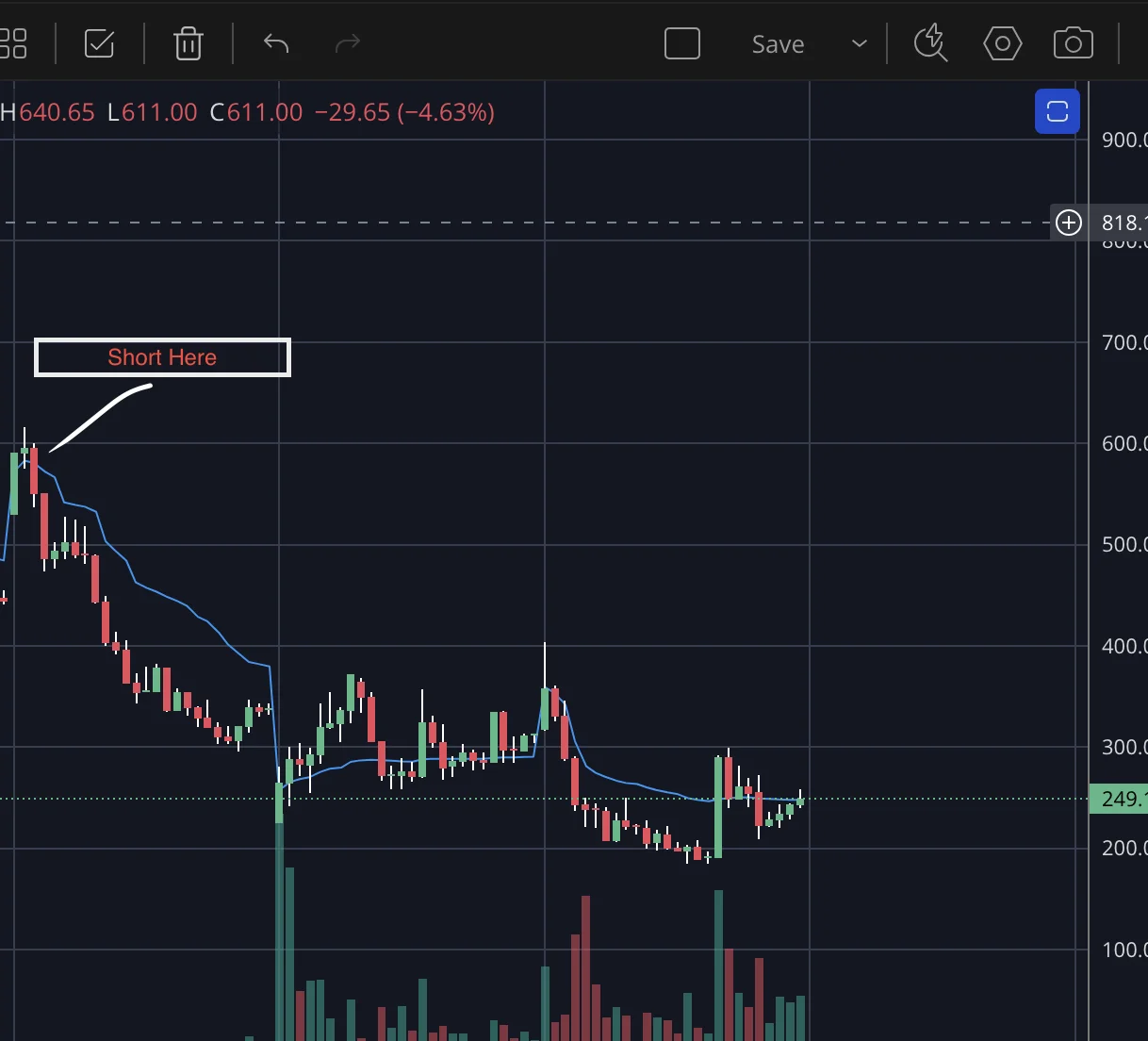
Look at what happens after the entry in the chart above. The premium makes several attempts to climb back to VWAP, but each one is sold, and VWAP keeps sloping down. That is the behaviour this setup is trying to capture: once an option fails at VWAP, time decay and seller pressure tend to keep it falling. With a 1:4 target, one good trade like this can cover several small losses.
Backtest Results (January 2025 to October 2026)
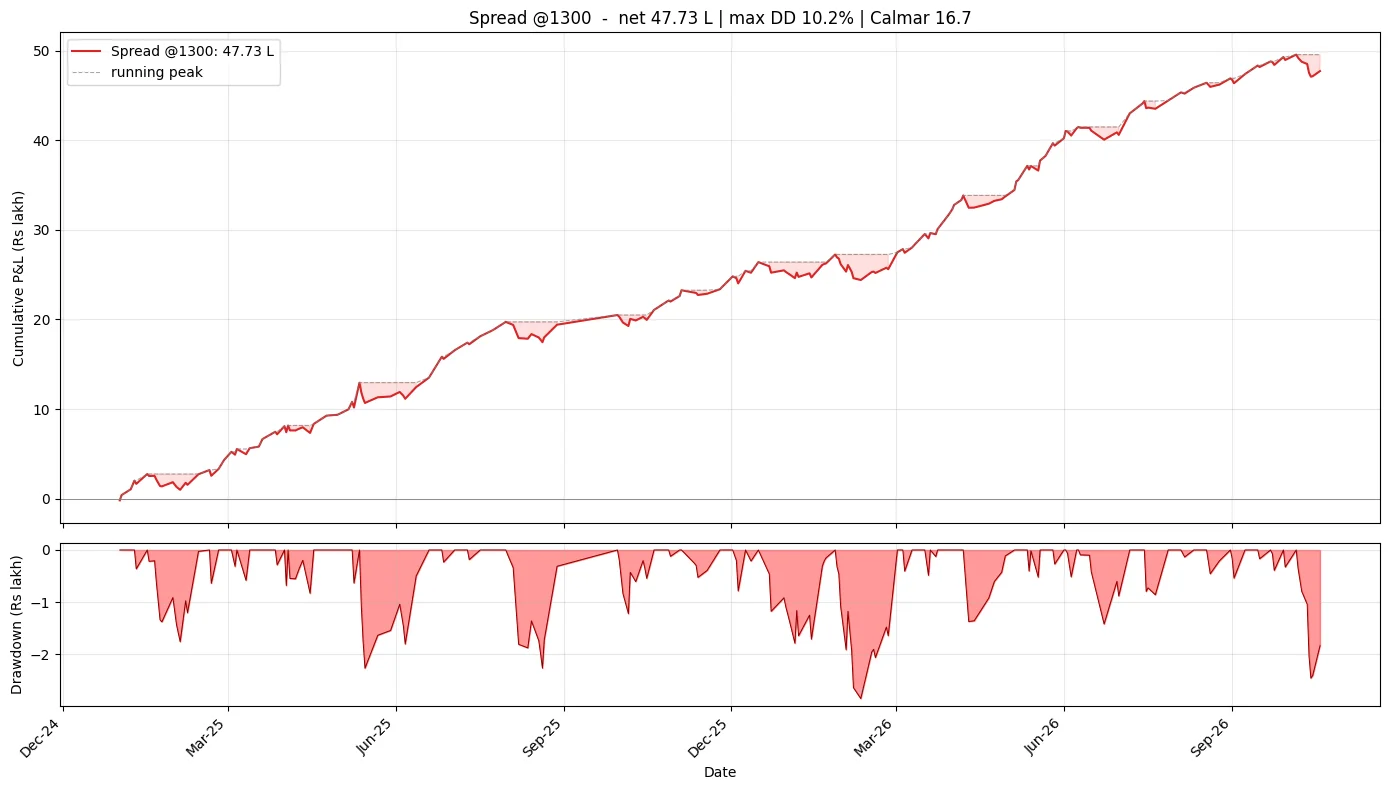
The rules above were backtested on Nifty ATM options as a hedged spread. Here are the full results, including costs:
| Metric | Result |
|---|---|
| Period | 2025-01-01 to 2026-10-19 (1.80 years) |
| Capital / size / cost | ₹28 L | 1,300 quantity | ₹700 per trade (2 legs) |
| Total trades | 294 |
| Wins / losses | 150 / 144 |
| Hit rate | 51.02% |
| Profit factor | 2.07 |
| Net P&L | ₹47.73 L |
| Total return (on ₹28 L) | 170% |
| CAGR | 74.0% |
| Maximum drawdown | 10.2% (about ₹2.8 L) |
| Expectancy per trade | ₹16,236 |
| Average win / average loss | ₹61,514 / −₹30,928 |
| Best / worst trade | ₹2,78,085 / −₹1,00,150 |
| Carried overnight | 140 of 294 (47.6%) |
| Average hold | 0.97 nights |
How to Read These Numbers
- Only half the trades won. A 51% hit rate is close to a coin flip. The profit comes from the size of the wins, not how often they happen.
- Winners were about twice the size of losers (₹61,514 vs ₹30,928). The plan targets 1:4, but not every winner reaches the full target, so the realised ratio is lower. That is normal.
- The hedge did its job. The worst trade was about −₹1 lakh, close to the maximum loss of a 150-point spread on 1,300 quantity. Without the hedge, the worst overnight gaps could have been several times larger.
- Almost half the trades were held overnight. If you're not comfortable carrying hedged positions, expect different results from an intraday-only version.
- Drawdowns were real. The largest came in February 2026, at about ₹2.8 lakh from the peak, and the curve went sideways for weeks between August and October 2025. The test even ends in a fresh drawdown.
Module 7: Trading Psychology: Focus on Execution, Not Outcomes
Look at the backtest again: 144 losing trades. A strategy that made ₹47 lakh on paper still lost almost every second trade. If you expect every trade to be profitable, you'll abandon a working system at exactly the wrong moment.
- Losing streaks are guaranteed. Over about 300 trades at a 51% hit rate, the maths says a run of around 7 losses in a row is likely at some point. That is the strategy working as expected, not breaking.
- Judge the process, not the trade. A trade taken exactly to the rules that hits its stop is a good trade. A random trade that happens to make money is a bad trade.
- Expectancy only shows up over many trades. ₹16,236 per trade is an average across 294 trades. Any single trade can be −₹1 lakh or +₹2.7 lakh.
- Don't skip signals. The best trade of the year often comes right after a losing streak, when you least want to click. Skipping trades after losses quietly destroys the edge.
- Never move the stop or remove the hedge. The worst losses in options trading almost always come from breaking a rule "just this once".
- No revenge trading. One signal, one position, fixed size. Doubling up to recover a loss turns a planned drawdown into an account-ending one.
- Keep a journal. Record every signal, whether you took it, your entry, stop, target and result. Your journal will tell you whether your problem is the strategy or the execution.
Your job isn't to predict the next trade. Your job is to execute the next trade exactly as planned, and let the edge play out over the next hundred.
Module 8: Test Every Strategy Free on MegaBull
The fastest way to turn this free options trading course into real skill is to practise without risking money. MegaBull is a free paper trading app built for Indian markets:
- Real-time NSE data: trade Nifty, Bank Nifty and stock options on live prices.
- ₹5 lakh virtual money: test option buying, selling, spreads and iron condors with zero risk.
- Multi-leg options: place the sell leg and the 150-point hedge together, just like the real setup.
- Analytics: track your hit rate, P&L and drawdown so you can compare your execution with the backtest.
- Free paper trading API: automate the 15-minute VWAP check with our paper trading API for India and let code handle the discipline.
Run the VWAP rejection setup on MegaBull for at least 30 to 50 trades. If your paper results look nothing like the backtest, you've found an execution gap to fix, before it costs real money. Size each trade with the free position size calculator, and read our guide on how to paper trade options to get started.
Start testing option strategies free on MegaBull →
Frequently Asked Questions
Is this options trading course really free?
Yes. Everything in this free options trading course is free to read, including the option trading strategies PDF cheat sheet. You can also practise every strategy on MegaBull's paper trading app with virtual money and real-time NSE data at no cost.
Which is better: option buying or option selling?
Neither is better for everyone. Option buying has limited risk and suits traders with small capital who expect fast, strong moves. Option selling wins more often because time decay works for the seller, but it needs more margin, strict risk control, and a hedge. Many experienced traders use both, depending on volatility and market conditions.
Can I download the option trading strategies PDF?
Yes. The free option trading strategies PDF in this article covers 12 strategies, option buying vs selling, a hedging example, and the full rules of the 15-minute VWAP rejection setup. It is a printable cheat sheet you can keep next to your trading screen.
What is hedging in option selling?
Hedging in option selling means buying a further out-of-the-money option of the same type when you sell an option. For example, if you sell the 23200 call, you buy the 23350 call. The bought option caps your maximum loss, protects you from overnight gaps, and lowers the margin required.
How much capital do I need to sell options in India?
A naked short Nifty option needs a large margin, often over one lakh rupees per lot. A hedged spread needs much less because the bought leg reduces risk. The backtest in this article used ₹28 lakh of capital for 1,300 quantity, but you should size positions so that a single loss is a small percentage of your account.
Does the VWAP rejection strategy win every trade?
No. In the backtest the strategy won only about 51% of its 294 trades, and it had losing streaks and drawdowns of up to 10.2% of capital. It made money because the average winner was about twice the average loser. No strategy wins every trade, and backtested results do not guarantee future returns.
How can I practise options trading without losing money?
Use a paper trading app. MegaBull lets you trade Nifty, Bank Nifty and stock options with virtual money on live NSE prices, so you can test option buying, option selling, spreads and the VWAP rejection setup before risking real capital.
Conclusion
Option buying gives you capped risk and big upside. Option selling gives you time decay and a higher win rate. Hedging is what makes selling survivable. Together with a clear, rule-based setup like the 15-minute VWAP rejection on ATM Nifty options, they form a complete toolkit. The final ingredient isn't a better indicator. It's the discipline to execute every signal and accept that losses are part of the plan. Download the option trading strategies PDF, practise on MegaBull, and go live only once your execution matches your rules.