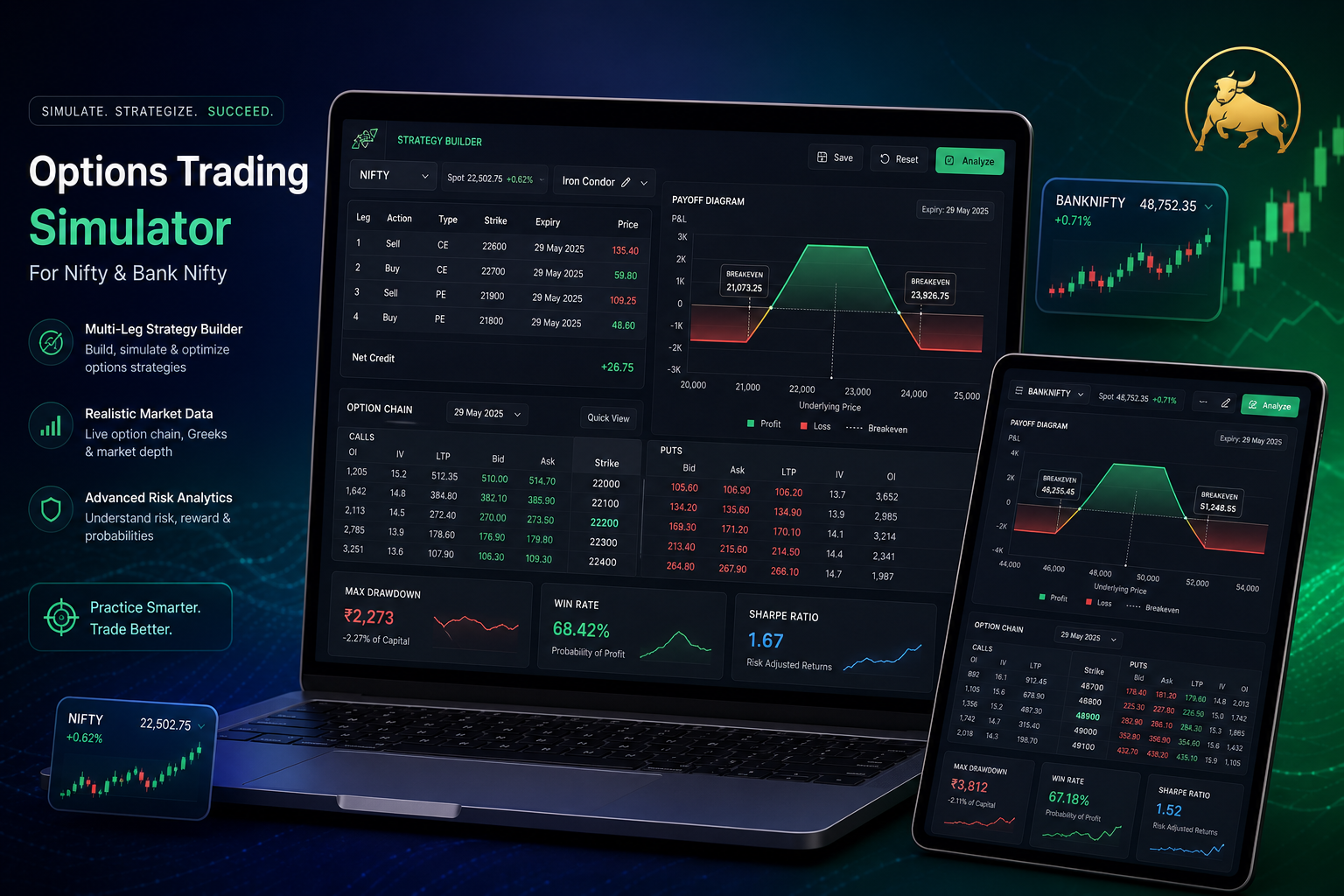
Most traders treat a stock market simulator like a video game, clicking buy and sell to see what happens. Serious options traders use it differently. A well-built options simulator is a research and validation tool: a place to construct multi-leg Nifty and Bank Nifty strategies, measure real risk, and prove an edge before a single rupee of real capital is on the line.
This guide walks you through exactly how to use an options simulator the professional way, from setting up spreads and strangles to tracking the risk metrics that actually matter.
Why an Options Simulator (Not Just a Stock Simulator)
A basic stock market simulator lets you buy and sell shares with virtual money. That is great for beginners, but options are different. Their value depends on strike, expiry, implied volatility, and time decay, so you need an options simulator that models a live option chain and multi-leg positions accurately.
- Realistic premiums: Live NSE option prices, not approximations.
- Multi-leg support: Build spreads, straddles, strangles, and condors as one position.
- Greeks & decay: See how theta and volatility affect the setup over time.
- Risk analytics: Measure drawdown and risk-adjusted return, not just raw P&L.
Step 1: Set Up a Multi-Leg Strategy in the Simulator
Let's walk through building two common Nifty / Bank Nifty strategies inside an options simulator.
Example A: Bull Call Spread (Directional, Defined Risk)
Use this when you are moderately bullish on Nifty and want capped risk.
- Select Nifty as the underlying and choose the weekly or monthly expiry.
- Buy an at-the-money (ATM) call from the option chain.
- Sell a higher out-of-the-money (OTM) call to reduce cost.
- Confirm the net debit, max profit, max loss, and breakeven shown on the payoff diagram.
- Add a stop loss and target, then forward-test through expiry.
Example B: Short Strangle (Premium Selling, Range-Bound)
Use this when you expect Bank Nifty to stay range-bound with falling volatility.
- Select Bank Nifty and choose the expiry cycle.
- Sell an OTM call above the expected range.
- Sell an OTM put below the expected range.
- Review combined premium collected and the breakeven band on the payoff curve.
- Set leg-wise stop losses to control the undefined-risk tails, then track daily.
Step 2: Track Risk Metrics Beyond P&L
Profit and loss is only one number. To know whether a strategy is genuinely good, an options simulator should help you measure these risk metrics over many simulated trades:
Maximum Drawdown
The largest peak-to-trough drop in your simulated equity curve. It answers the most important survival question: how much pain would I have endured? A strategy with great returns but a 60% drawdown is psychologically and financially unviable for most traders.
Win Rate
The percentage of trades that were profitable. High win rates feel good, but they must be read alongside risk-reward. A short strangle may win 80% of the time yet lose big on the other 20%, so win rate alone never tells the full story.
Sharpe Ratio
A measure of risk-adjusted return, how much return you earned per unit of volatility. Two strategies can have the same profit, but the one with the higher Sharpe ratio delivered it more smoothly. Use the simulator to compare Sharpe across variations of the same setup before committing capital.
| Metric | What It Tells You | Why It Matters |
|---|---|---|
| Max Drawdown | Worst losing streak | Tests survivability & position sizing |
| Win Rate | % of profitable trades | Sets expectations & psychology |
| Risk-Reward | Avg win vs avg loss | Validates edge with low win rates |
| Sharpe Ratio | Return per unit of risk | Compares strategy quality fairly |
Step 3: Validate Systematically, Don't Curve-Fit
The biggest mistake in simulation is tweaking a strategy until it looks perfect on one period, only for it to fail live. Test across multiple expiries and volatility regimes, and confirm the metrics hold up. If your edge only appears after twenty parameter changes, it probably isn't real. Our guide on backtesting vs. live forward testing explains how to avoid this trap.
Why MegaBull Is Built for Systematic Strategy Validation
Many simulators are gamified, fun, but shallow. MegaBull is engineered for serious options traders who want to validate strategies systematically:
- Real-time NSE option chains for Nifty, Bank Nifty, and stock options
- Multi-leg strategy support with accurate premiums and payoff visualization
- Risk analytics including drawdown, win rate, and performance reports
- Forward testing in live market conditions to confirm your edge is genuine
- Rs 5 Lakhs virtual capital, professional charting, and detailed journaling
- 100% free, with no premium gates blocking core features
Your Simulation Workflow (Recap)
- Build: Set up a multi-leg Nifty / Bank Nifty strategy in the options simulator.
- Measure: Track max drawdown, win rate, risk-reward, and Sharpe ratio, not just P&L.
- Validate: Test across expiries and volatility regimes to avoid curve-fitting.
- Execute: Fund the strategy with real capital only after it passes validation.
Frequently Asked Questions
What is an options simulator?
An options simulator is a stock market simulator that lets you build, test, and track options strategies using virtual money in real or historical market conditions. It mirrors live NSE option chains so you can practice multi-leg strategies like spreads and strangles without risking real capital.
How do I use a stock market simulator for options?
Choose your underlying (Nifty or Bank Nifty), select an expiry, add each leg of your strategy from the option chain, set quantities and stop losses, then run or forward-test the position. Track P&L plus risk metrics like max drawdown, win rate, and Sharpe ratio to validate the strategy.
Can I practice Nifty and Bank Nifty options strategies in a simulator?
Yes. A good options simulator like MegaBull supports live Nifty and Bank Nifty option chains, so you can practice bull call spreads, short strangles, iron condors, and other multi-leg strategies in realistic conditions before going live.
What risk metrics should I track in an options simulator?
Look beyond P&L. Track maximum drawdown (worst peak-to-trough loss), win rate (percentage of profitable trades), average risk-reward, and the Sharpe ratio (risk-adjusted return). These metrics reveal whether your edge is genuine and survivable.
Is MegaBull a good options simulator?
MegaBull is built for systematic strategy validation, not gamified guessing. It offers real-time NSE data, live option chains, multi-leg strategy support, and detailed analytics, all free, making it a strong stock market simulator for serious options traders.
Conclusion
An options simulator is far more than a practice toy, it is a systematic research lab for mastering Nifty and Bank Nifty strategies. By building multi-leg positions and measuring real risk metrics like max drawdown, win rate, and Sharpe ratio, you replace guessing with evidence. Start validating your strategies on MegaBull today, and trade live with confidence.